

What is iMario?
Choose an audience, run research, and inspect the evidence behind a decision.
此页译文尚未提供,当前显示英文原文。
iMario lets you ask questions of modelled audiences, compare alternatives, and explore the reasoning behind their responses. Start with the decision you need to make: which message to use, what customers object to, or what to investigate with real people.
Start with a task
Open New Task in your workspace. Choose an audience and describe your question. The composer supports a single question, a survey, an interview, a focus group, a preference test, a creative test, or URL feedback. Each format asks for the material it needs.
You can use an available audience immediately. Building new individuals or connecting a canvas is not a prerequisite for a first study.
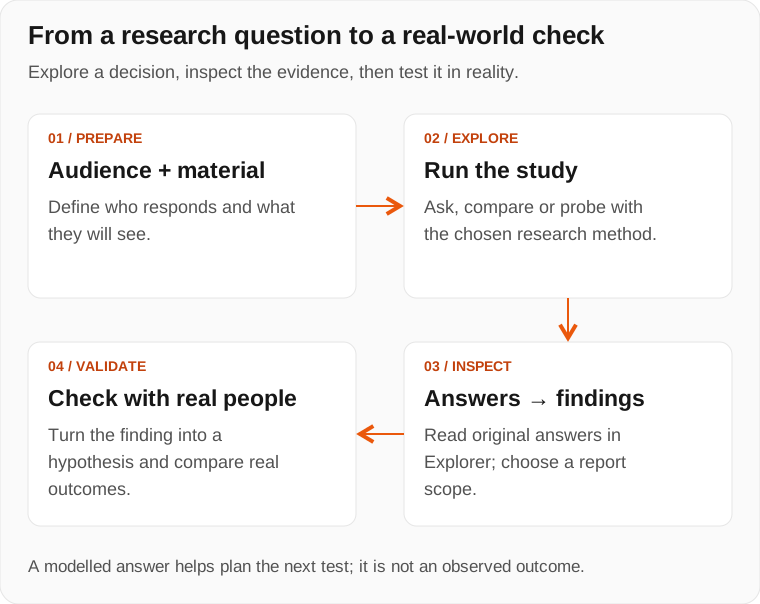
- Choose who responds. Check the audience's definition and sources.
- Prepare the question or material. Review the questionnaire, guide, options, image, or page being tested.
- Set the size and run. Check the respondent count and credit estimate before submitting.
- Explore the result. Read distributions, themes and individual answers; compare segments and ask follow-up questions.
- Write a report when needed. A report combines a chosen scope of research and has its own charge.
Find the right guide
Your first study
Run one question and inspect its result.
Choose a research method
Match your decision to the right input and output.
Choose an audience
Use an existing audience or build one from your data.
Understand the evidence
Separate observed data, modelled answers and interpretation.
Reuse your work
Audience holds the people and populations you study. Library holds reusable surveys, discussion guides, images, documents and reports. Knowledge Base supplies background for connected individuals. Projects help organize tasks within a workspace.
New accounts receive 1,000 credits. Research, report generation and audience access are explained in Pricing & credits.
Synthetic results support exploration and comparison. They are not observations of people using your product and do not establish an exact future conversion rate. Use real validation to check decisions that depend on that distinction.