

Pricing & Credits
Understand research rates, report generation, credit purchases and audience access.
iMario meters research with credits. New accounts receive 1,000 one-time credits. Access to certain markets and official audiences is purchased separately from running studies.
Research rate card
| Action | Credits |
|---|---|
| Closed single-choice question | 1 per respondent per question |
| Multi-select question | 1 per option per respondent |
| Ranking question | 1 per ranked item per respondent |
| Open question, including an open survey question | 2 per respondent per question |
| Open interview-guide question, including probing | 5 per respondent per question |
| Text-only preference test | 1 per respondent |
| Visual preference test | 2 per respondent |
| Creative test | 2 per respondent |
| URL page feedback | 5 per respondent |
| Focus group | 5 per seated participant per topic |
| AI analysis of a selected Explorer group | 10 per analysis |
| Direct individual chat | 1 per message |
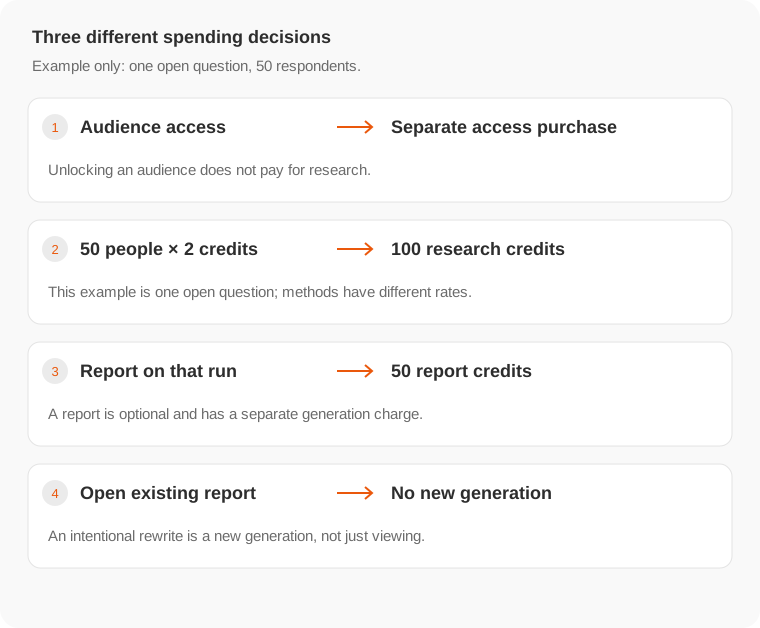
Survey and guide prices add the rates of their question types. Instruction blocks are not respondent questions. A multi-select question with six options costs six times a single-choice question for the same panel size.
Creating a synthetic individual, importing from LinkedIn or creating from an assessment no longer carries the old 20-credit creation charge. Preparing a questionnaire is separate from running research.
Reports
A report is charged on the credits of the runs it covers:
| Portion of covered run credits | Report rate |
|---|---|
| First 1,000 | 50% |
| Next 4,000 | 25% |
| Above 5,000 | 10% |
The result is rounded up, with a minimum of 20 credits per new generation. Deep analysis is included; the old 50-credit Deep Dive upgrade is retired.
Opening an existing report is different from generating it. An explicitly confirmed rewrite is charged again. A new report with a wider scope is priced on all the runs it now covers. Duplicate requests for the same in-progress generation are handled separately from intentional regeneration.
Worked examples
| Study | Research cost | Report if requested |
|---|---|---|
| One open question, 50 respondents | 50 × 2 = 100 | 50 |
| Five single-choice questions, 100 respondents | 5 × 100 = 500 | 250 |
| Five open interview questions, 50 respondents | 5 × 50 × 5 = 1,250 | 563 |
| Three focus-group topics, eight participants | 3 × 8 × 5 = 120 | 60 |
| Report covering 6,000 run credits | Already incurred by the runs | 500 + 1,000 + 100 = 1,600 |
For the 1,250-credit study, the report is 500 plus 62.5, rounded up to 563. A report does not have to be requested to inspect the study's result.
Buy credits
One-time purchases cover 500–4,999 credits at $0.05 per credit. Monthly credit packs provide the bulk rate:
| Monthly credits | Monthly price |
|---|---|
| 5,000 | $200 |
| 10,000 | $400 |
| 20,000 | $800 |
Review the current pricing page and checkout before purchasing. Existing subscriptions may have their own renewal terms. The former per-plan feature and resource quota tables do not describe the current credit-metered product.
Audience access
Workspaces receive two free market slots. Extra market access is $200 per market. Official audience pricing depends on class and size; base packages start at $500 for consumer audiences and $1,250 for B2B audiences. Healthcare-professional and sensitive categories require contacting the team.
These are access purchases in dollars, not credits to spend on studies. Research still incurs its normal credit charge. Review the precise audience package in its unlock dialog.
Charges and refunds
Check the task's count and estimate, and use these rates to understand the scope. In particular, visual preferences and long focus groups must be budgeted using their actual material and topic count.
Charges and refunds appear in Usage. A failed or interrupted task is not automatically a full refund: check the recorded event and completed work. Contact support if the ledger does not match what happened.