iMario vs Electric Twin: Who Shapes the Study?
How iMario builds around a company's own customer data, and how Electric Twin's Research Agent approaches study design.
Imagine a subscription fitness app whose annual subscribers renew less often than planned. Finance wants to offer the subscribers approaching renewal a cheaper annual plan. The question is the familiar one behind any discount: would the cheaper plan keep enough subscribers to make up for the revenue given up by people who would have renewed at the existing price anyway? The company, its data and the proposal are hypothetical, and no study has been run on them.
Nobody can know in advance which subscribers fall into that last group. Whether someone "would have renewed anyway" describes what they would have done at a price they won't be offered once they get the discount. Synthetic research earns its place before that point: it shows how each group of subscribers says it would respond to each price, so the team can narrow the offer to the versions worth testing, and a live test then measures what the chosen one does to renewals and revenue.
To do that well, a research team has to build the right audience, ask questions that bear on the decision, and show where its conclusions came from. iMario and Electric Twin both build synthetic audiences from a company's own data, so this isn't a contest between real data and generic AI. The question this article follows is who shapes the study. With iMario, an assistant can draft the study, but the team assembles the audience from its own customer records, inspects how it was built, and reviews the study before it runs. Electric Twin's Research Agent, in its Autonomous mode, is designed to take a question or brief and choose the study's approach, audiences, questions and methods itself. Those are different divisions of labor, and they leave the team with different things to check.
Starting from the customers you already have
Assume the company keeps a subscriber roster with each subscriber's plan type and renewal date, plus observable account signals such as recent activity and past renewal history. It also has in-app survey answers and the reasons people gave when they cancelled. Those can be tied to the roster only where they carry a stable identifier, such as the subscriber ID.
In iMario, that roster is where the audience starts. Customer records establish who is in the audience; here, that means the subscribers approaching renewal, identified from their renewal dates. Survey responses add structured answers, and interviews and feedback add language and context, as long as they share a stable customer ID or email with the records and so describe the same people. A transcript on its own doesn't define anyone: "a transcript or product brochure alone is not necessarily a customer roster."1
The matching matters for a pricing question. A survey answer that can't be linked to a subscriber says nothing about that subscriber. Cancellation reasons come from people who have already left, so they may hint at why subscribers go but say nothing about what anyone in the upcoming cohort will do. Account signals let the team compare groups with different observable risk of leaving, which is useful, though risk is not the same as knowing who would renew at the existing price.
iMario makes the build itself inspectable. Before the audience is created, the researcher checks field matches, identifiers, source roles and anything excluded from the build. Afterwards, they can compare the audience's distribution and definition with the source data and look at source coverage and example people.1 Before a single question is asked, the team can see how many renewing subscribers carry linked survey evidence and which records fell out.
Where the company's own records run thin, iMario extends them. Its audiences are "built from your real people data, extended by a built-in simulated world population," which today covers 5.5 billion simulated people across 61 markets.2 That population is built from official statistics and kept calibrated against real survey data.3 Around the renewal cohort, that broader layer can fill gaps in context. It describes people like the app's subscribers, not the subscribers themselves, and the coverage checks are what keep that line visible.
Electric Twin starts from customer data too. Its homepage's first step is headed "We build your audience" and reads "We take your existing survey data and build a synthetic model of your customer"; the second is "You ask the questions."4 Its FAQ says audiences are built "from your customer data or high-quality real-world data." It describes a first conversation with its team about "what data you have, what shape it's in and what we can build from it," and says the team will "tell you upfront where the model will be reliable and where its limits are."5 Every audience, the homepage says, "is tested against real survey data before it goes live."4 Electric Twin's accuracy page describes that test: when onboarding a new customer, it builds the audience from part of the customer's data and scores it on questions held back from the build.6
So both products ground the audience in the company's data, and Electric Twin backs its audiences with a validation test. Where they part is in how the grounding happens. Electric Twin describes it as work involving its team at onboarding; in iMario, the team does the build itself in the product and checks coverage before any study runs. If finance is likely to ask exactly which subscribers a finding rests on, it helps to know whether that answer will come from a conversation or from the audience itself.
Shaping the questions
The hardest part of the pricing study is the wording. The questions have to separate willingness to pay at each price from general satisfaction with the app, or the answers will flatter the discount without saying anything about renewal.
With iMario, the team writes that study or reviews it before anything runs. The researcher selects the audience for a new task, prepares the question or material, and sets the respondent count before submitting.78 Formats include a single question, a survey, an interview and a focus group, among others.7 An assistant "may ask clarifying questions before drafting the task," and a goal can be turned into a draft questionnaire that opens in a builder, where the researcher checks every question, response type and option.910 Before running, iMario's checklist asks whether the audience matches the people intended, whether the questions and options are complete, whether the method fits the job, and whether the respondent counts and question list are intentional.9 By the time the study runs, the willingness-to-pay wording, the format and the confirmation that the audience is the renewal cohort have all been settled by people who can explain them.
Electric Twin offers two ways in. Users can log in and ask questions directly of what its FAQ calls an "always-on audience," which leaves the framing with them.5 For a full study, the Research Agent page says to "give it a question or a brief to get started." The agent then "comes up with the study approach and selects the right audiences." It "chooses what questions to ask, picking the right methodologies and analysing findings to follow the research," and "checks its own results and looks for evidence to support them as it runs." Users "switch to Autonomous" for this, and the page says a full report can arrive "in as little as 30 minutes."11 Electric Twin's announcement adds that the agent "runs hundreds of surveys and focus groups, and keeps going until it finds an insight worth sharing."12
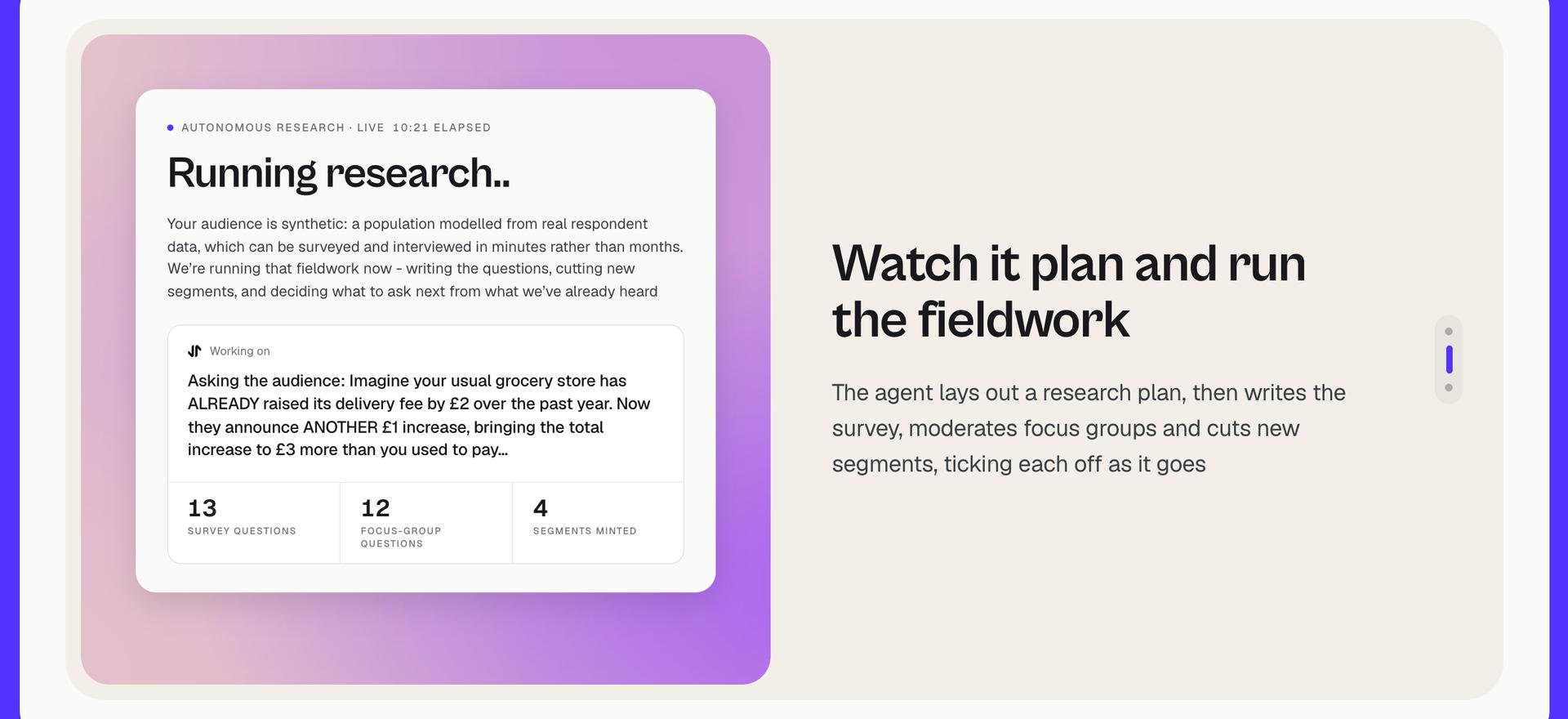 A still from the animated demonstration on Electric Twin's Research Agent page (https://www.electrictwin.com/platform/research-agent), captured 21 October 2026. It is a website demonstration, not a verified product screenshot; its sample question and counts are Electric Twin's illustration, not results from this article's hypothetical fitness app.
For a team short on time, handing over a brief and getting a designed study back is a genuine advantage. It also moves the work. Instead of writing the pricing questions, someone has to assess the ones the agent chose: was its audience the upcoming-renewal cohort, do its questions bear on renewal at each price, and did it stop somewhere defensible? Those are the same tests an iMario researcher applies to their own draft, but applied to choices someone else made, and possibly after the study has run. The page's demonstration shows the agent laying out a research plan and ticking off each step as it goes; whether a team can change that plan before it runs is a question to put to Electric Twin directly.
Tracing a finding back to the people behind it
Suppose the study comes back with "the cheaper plan appeals most to low-activity subscribers." Finance will want to know which subscribers, which questions and which answers support it.
iMario is set up for that conversation. After a run, Explorer "is the analysis panel behind a result." It shows who gave an answer and lets the researcher combine answers into a group and compare that group by another question or a demographic. A group can be saved with Add Segment, and each respondent's answers can be read individually. A follow-up chat with a respondent produces "a new response, given after the original run," kept apart from the original answers, and the AI analysis "gives an interpretation of the selected group."13 The researcher can then generate a report that "brings one or more completed runs together into a written synthesis." Its Responses tab shows each respondent's details and answers, and its Code Book tab shows how each answer was coded, with its label, sentiment, respondent and quote, so a reader can "trace a theme back to the answers behind it." The guidance that comes with it is blunt: "Check each recommendation against the evidence; a confident sentence is not proof."14 With the low-activity claim, that means being able to show the group behind it in Explorer and the coded answers behind the theme in the report.
Electric Twin describes its own ways of looking inside an audience. Its Audience Discovery page talks about seeing "how your audience splits," hearing "the reasons in their own words," and following up "on any response and keep asking until the reason is clear."15 For agent-led work, the Research Agent page describes a report that can be shared or used "as the starting point for what you want to explore next," with an example summarized as "70 questions · 8 segments · 5 focus groups."11 An agent working at that scale produces a lot behind each finding. In a demo, it is worth asking how much of it a reader can open, including the paths the agent tried and dropped.
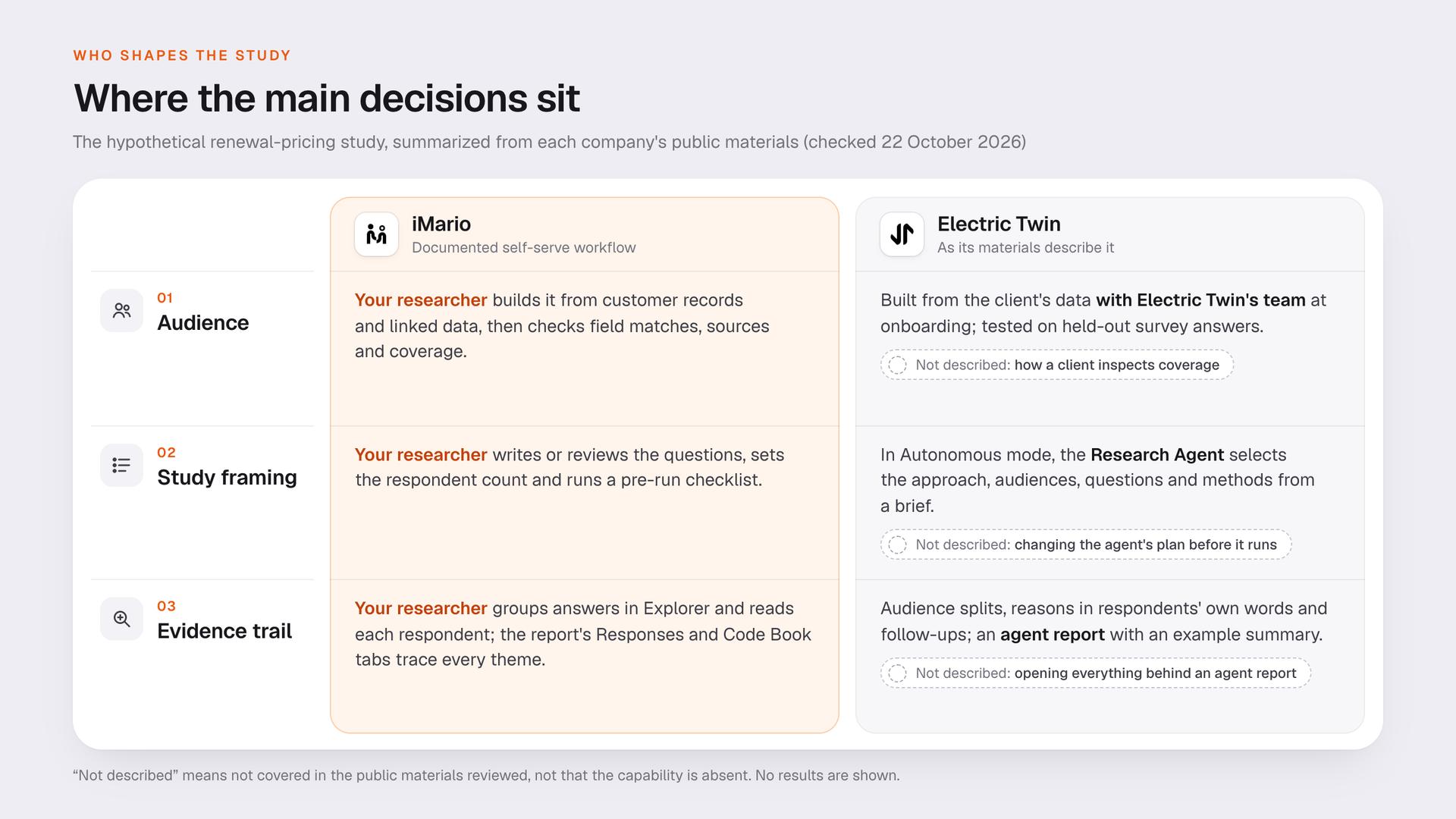 Where the main decisions sit for the hypothetical pricing study, summarized from each company's public materials as cited in this article. "Not described" marks steps the reviewed materials don't cover, not missing features. No results are shown.
How much weight the evidence can carry
Source coverage is what went into the audience: how much of the renewal cohort has linked survey answers, and where population data filled in. Audience fit is how closely the synthetic audience resembles the company's subscribers. Good coverage and close fit make the audience a faithful starting point; how accurately it then predicts is a separate question, answered by validation.
Validating an audience is a further step. Electric Twin's onboarding test measures how closely an audience reproduces held-out survey answers.6 That is real evidence about the audience and the model, but it doesn't validate a particular finding from a particular study, because a well-validated audience can still be asked a badly framed question. Each company publishes its own accuracy evaluation on its own data, so their headline figures can't be ranked against each other, even where both report the same measure, 1-MAE.6 Ours is built so a buyer can check it: it scores every question blind across 11 populations on public survey data, publishes the data and scoring code so anyone can rerun it, and leads with 1-TV, the stricter of the two standard measures, at 88.9%.16
Searching widely adds its own risk. Look across enough groups and questions and some differences will appear by chance; statisticians call this the multiple-comparisons problem, and reporting only the striking results makes it worse. The risk grows with the number of comparisons. A researcher clicking through segments in iMario's Explorer faces it too, and it matters more for an agent that, by its own description, "runs hundreds of surveys and focus groups, and keeps going until it finds an insight worth sharing."12 How that search is accounted for, and what the agent's self-checks compare against, are fair questions for a demo rather than evidence of a flaw.
Observed behavior is the one thing no synthetic study supplies, which is why both companies point to real-world checks. Electric Twin says it may recommend primary research first for very thin or newly formed audiences, and that regulated claims need real people on record;6 our validation guide sets out how to compare a particular study with newly collected responses.17 For the renewal offer, either product can show how the upcoming cohort says it would respond and which groups look worth watching. The actual renewal uplift, the revenue given up to subscribers who would have renewed anyway and the net effect on revenue come from a live test.
Testing the workflow, then the offer
The fairest way to choose is to run the same pricing question through both. Give each product the same audience boundary (subscribers approaching renewal in a defined period, with any risk groups defined from the roster's observable signals), the same roster and linked data where possible, and the same question. Agree the review criteria in advance:
- Does each question bear on renewal at each price?
- Does the audience match the boundary?
- Is the wording neutral?
- Did the work stop at a defensible point?
- How long does it take to trace three headline findings to the answers behind them?
Have a researcher who ran neither study score both outputs, with vendor names removed where feasible. Output formats may still give the source away, so treat the review as anonymized, not blind. Identical inputs won't guarantee equivalent audiences, because each product builds its audience differently, so record how the resulting audiences differ. If they aren't sufficiently comparable, differences in their answers can't be attributed to workflow or research quality alone; report the mismatch as a limitation of the pilot, not as a win or loss for either product.
A pilot like this compares workflows. It can't show whether either study predicts what subscribers will do. To estimate the offer's actual effect, where commercially and legally appropriate:
- randomly assign eligible subscribers with upcoming renewals to receive either the cheaper plan or the existing price
- define the outcomes in advance, such as the renewal rate and net revenue per subscriber
- decide beforehand what result would support, revise or reject the plan17
A before-and-after comparison alone can't reliably separate the plan's effect from seasonality or other changes. Electric Twin, for its part, describes periodic real-world validation as how its models stay calibrated.6
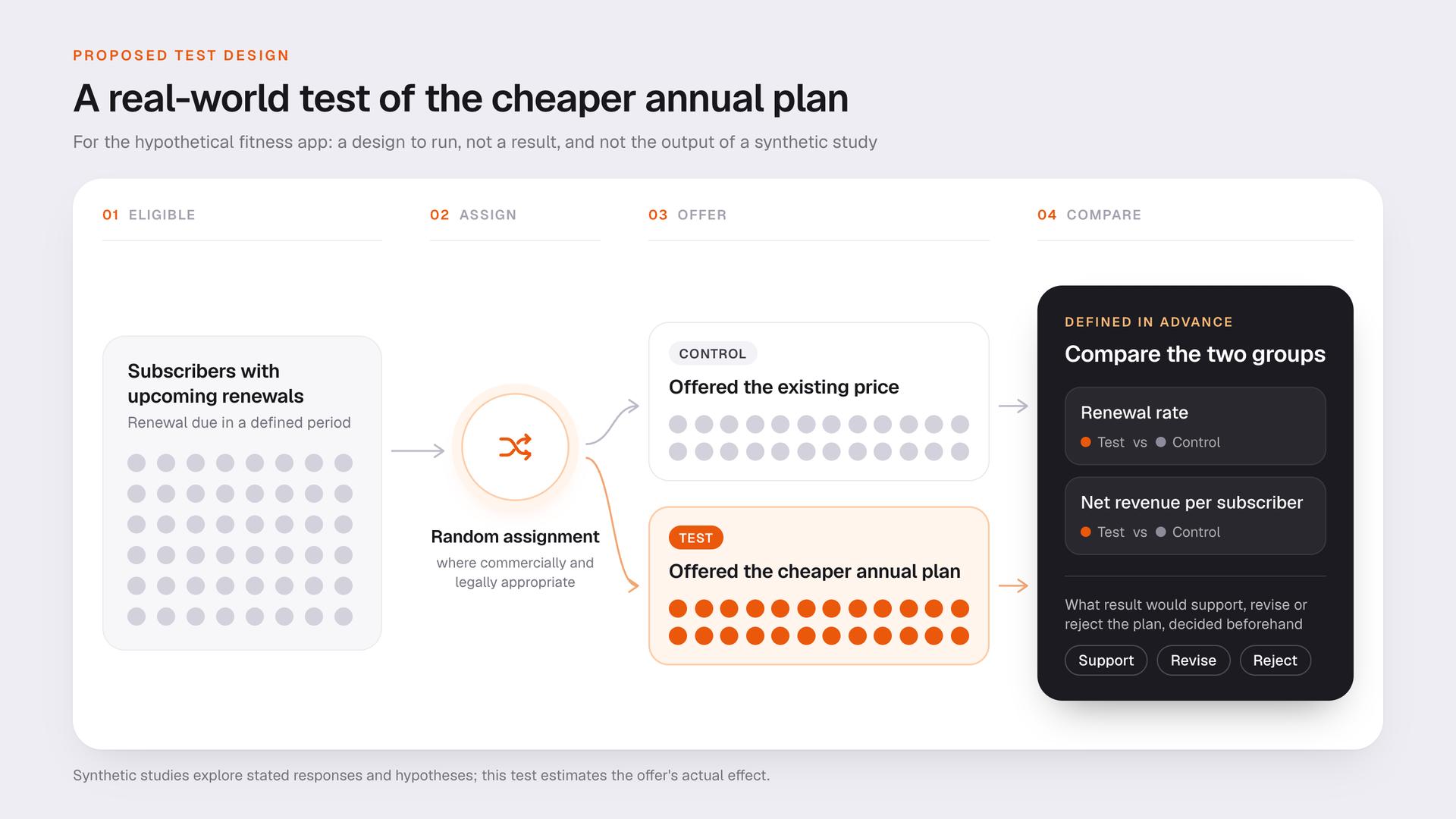 A proposed test design for the hypothetical company. It shows no results and is not the output of a synthetic study.
Questions to bring to the demos
- Electric Twin:
- how audience construction is divided between its team and the client, and how a client sees what the audience covers
- whether the Research Agent's plan can be reviewed and changed before it runs
- what can be opened behind each finding in an agent report
- what the agent's self-checks compare against, and how it decides to stop
- iMario:
- how your roster and linked survey and cancellation data map onto source roles and field matches
- what the trail from a report to coded responses looks like for a study like this one
The decision principle
A pricing recommendation gets challenged on its evidence: which customers, which questions, which answers. Choose the research setup that lets your own team answer those questions. That is what iMario is built around. The audience starts from the company's customer records, the team can see what population data added, the study is defined and checked before it runs, and a report's themes can be traced to the coded answers and respondents behind them, from a model whose accuracy benchmark anyone can rerun. An agent that designs the study can save real time, as long as the team can still inspect what it chose. Either way, the synthetic study narrows the offer to the version worth testing, and a live test with real subscribers settles the launch.
Sources
All sources accessed 21–22 October 2026. Vendor sources reflect each company's own claims.
Footnotes
-
iMario docs, "Build an Audience from Your Data": https://imario.ai/docs/audiences/build-from-data (vendor documentation). ↩ ↩2
-
iMario, homepage: https://imario.ai/ (vendor). ↩
-
iMario, "iMario 2.0: The Human Voice Behind Every Decision," 15 September 2026: https://imario.ai/blog/introducing-imario-2-0 (vendor). ↩
-
Electric Twin, homepage: https://www.electrictwin.com/ (vendor). ↩ ↩2
-
Electric Twin, FAQ: https://www.electrictwin.com/faq (vendor; data sources and workflow). ↩ ↩2
-
Electric Twin, Accuracy: https://www.electrictwin.com/accuracy (vendor-published evaluation description and stated limitations). ↩ ↩2 ↩3 ↩4 ↩5
-
iMario docs, "What is iMario?": https://imario.ai/docs/getting-started/overview (vendor documentation). ↩ ↩2
-
iMario docs, "Choose an Audience": https://imario.ai/docs/audiences/choose (vendor documentation). ↩
-
iMario docs, "Run, Review and Follow Up": https://imario.ai/docs/research/run-and-follow-up (vendor documentation). ↩ ↩2
-
iMario docs, "Use the Questionnaire Builder": https://imario.ai/docs/materials/questionnaire-builder (vendor documentation). ↩
-
Electric Twin, Research Agent: https://www.electrictwin.com/platform/research-agent (vendor product page; includes an example report). ↩ ↩2
-
Electric Twin, "Introducing our research agent," 29 September 2026: https://www.electrictwin.com/blog/introducing-our-research-agent (vendor). ↩ ↩2
-
iMario docs, "Explore Results": https://imario.ai/docs/run-and-analyze/explorer (vendor documentation). ↩
-
iMario docs, "Generate and Read a Report": https://imario.ai/docs/run-and-analyze/reports (vendor documentation; Responses and Code Book tabs). ↩
-
Electric Twin, Audience Discovery: https://www.electrictwin.com/platform/audience-discovery (vendor product page). ↩
-
iMario Accuracy Benchmark v2: https://imario.ai/synthetic-audience-benchmark (vendor-published). ↩
-
iMario docs, "Validate with real world data": https://imario.ai/docs/run-and-analyze/validate (vendor documentation). ↩ ↩2