Five AI Shifts in Product Development
For the past two years, most conversations about generative AI have circled the same question: how much more productive can it make engineers?
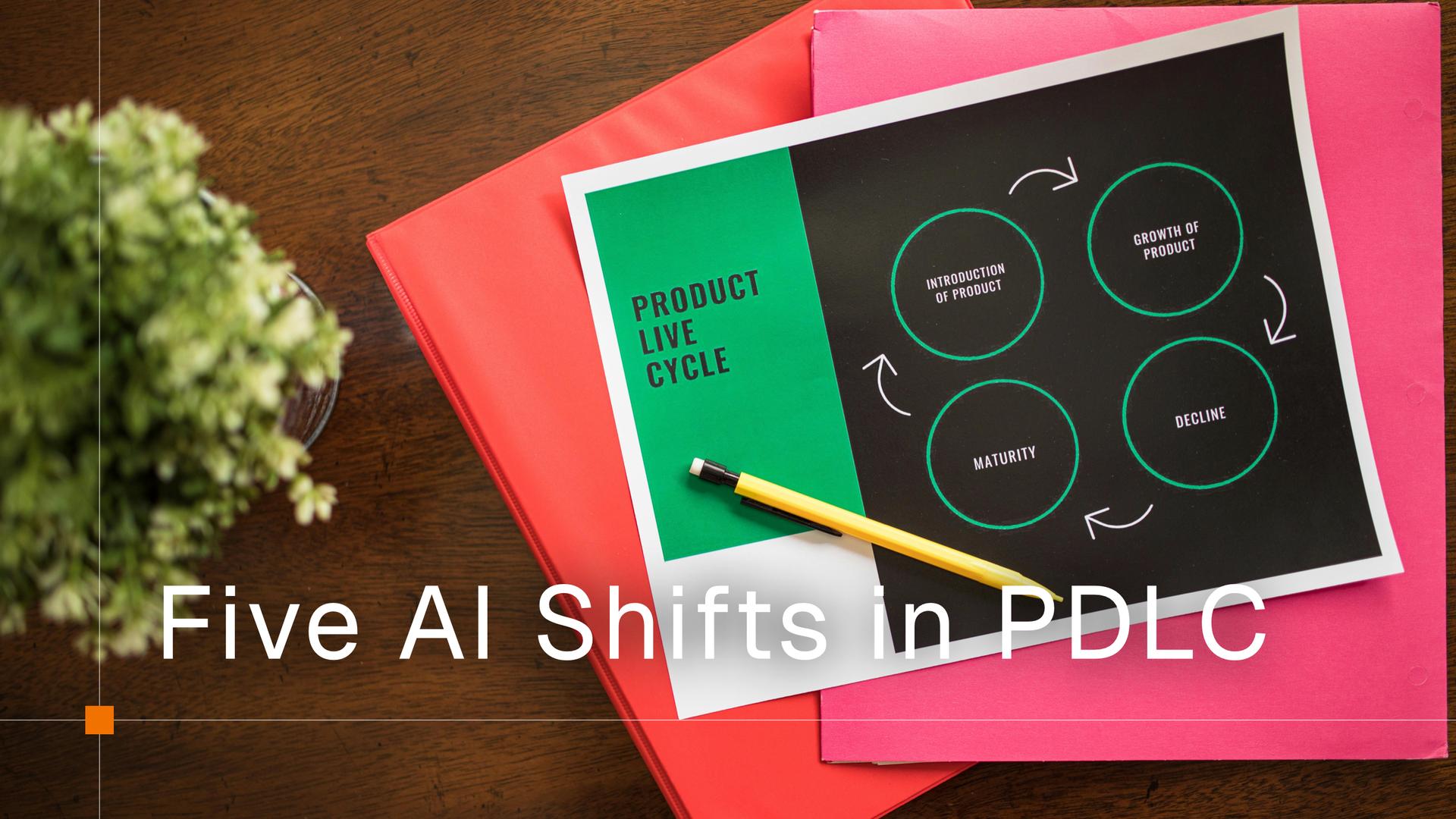
That's a valid question, and the answers are already coming in. McKinsey estimates that gen AI could contribute $2.6 to $4.4 trillion to the global economy, with engineering efficiency as a meaningful part of that. But engineering productivity is a starting point, not an end state. The more important question lies further along: when AI reshapes every stage of the product development life cycle (PDLC), what actually changes — and what doesn't?
A Real Problem — Not a New Discovery
Anyone who has worked in user research knows that fragmented customer insight is not a recent revelation.
Decades of methodology have been developed precisely to address this challenge — focus groups, ethnographic research, longitudinal tracking studies. The methods exist. The problem has never been a lack of good techniques. It's that the outputs of those techniques rarely flow into product decisions in real time.
A product manager collects a set of perspectives from user interviews. The marketing team brings back a different batch of data. Customer support feedback sits in yet another system. These insights get written into reports — and by the time they're read, discussed, and converted into a product decision, weeks or months have passed. McKinsey's recent report describes this as a structural issue: the software PDLC suffers from fragmented data sources and dispersed product ownership.
The core tension is this: user needs move continuously, but our understanding of them is frozen in time.
AI is closing that gap. Here are five shifts that industry leaders are already living through.
Five Shifts Already Underway
1. Time-to-market is being redefined
Much of the acceleration comes from AI absorbing the routine work that used to consume PM, engineering, and design hours — project management, market analysis, performance testing, feedback analysis and documentation. What gets freed up is room for the higher-value work that actually moves products forward: strategy, concept development, feature prioritization.
More than speed, what changes is the rate of hypothesis validation — teams can now test more bets in the same window of time.
2. Customer value lands sooner, because data lands sooner
Traditionally, it took several releases for customer feedback to actually shape a product — telemetry, support tickets, user interviews, and competitive data lived in different systems with lagging cycles. AI is stitching those fragmented sources together inside the development loop, so products can be linked to customer value from the outset, rather than only after a few release cycles spent guessing on real users.
The same dynamic moves validation earlier: with user signal embedded in decisions from the start, teams no longer have to wait until launch to find out whether a product idea holds up.
Stack Overflow uses AI to comb through past and current customer research and feedback, surfacing insights to teams as they iterate. A product is no longer a snapshot; it becomes a continuously responsive system.
3. Good ideas stop dying in conference rooms
The hidden costs of traditional product development are steep: expensive prototyping, long research cycles, and the slow erosion of good ideas as they pass through layers of approval. The result is that many promising ideas never reach a user — not because they weren't good, but because validating them was too costly.
Reddit's CPO Pali Bhat describes how AI collapses this barrier on his team: "New feature definition, prototyping, and testing are all happening in parallel and faster than ever before. Our teams can now dream up an idea one day and have a functional prototype the next." When the cost of testing an idea drops low enough, ideas no longer have to compete for scarce prototyping resources.
Twilio's CPO Inbal Shani articulated the role AI plays in injecting objectivity into this process:
"Having more data points can change business leaders' strategy and prioritization decisions. AI can help analyze data sets and be an unbiased element in the conversation. After strategic decisions are made, AI can then help continuously monitor metrics and evaluate the progress."
4. The product manager's scope is expanding
AI tools are enabling product managers to take end-to-end ownership — from ideation through to value delivery — with less dependence on cross-functional coordination. This doesn't mean other roles disappear; it means PMs can move more decisions forward independently.
Adobe's Varun Parmar anticipates that as AI absorbs more execution-layer work, the boundaries between product management and product marketing will blur — both roles converging toward higher-order strategic judgment.
5. Quality and compliance shift from afterthoughts to defaults
Security reviews and compliance checks used to arrive late in the development process, as remedial add-ons. AI-native development embeds these concerns from the first line of code. GitHub's enterprise AI tooling can accelerate code reviews by up to seven times, surfacing and fixing vulnerabilities earlier than traditional approaches allow.
Where We Land on These Five Shifts
Of the five, two are within reach for almost any product team today: moving validation earlier and lowering the cost of experimentation. They require new habits more than new infrastructure. A small team can start running cheap, fast validation rounds before lunchtime — the tools already exist and are improving weekly.
The other three — development acceleration, expanded PM tooling, and compliance infrastructure — are real, but they sit on top of code tooling, org redesign, and platform-level investment. They unfold over years, not weeks, and they're owned by engineering and platform leadership more than by the product team itself.
That asymmetry matters. If you're a product team reading McKinsey's piece and wondering where to start, the honest answer is: start with the two shifts where the marginal cost of moving is low and the payoff lands within a quarter. The other three will catch up, but they're not yours to drive on a Friday afternoon.
One thing McKinsey hints at but doesn't quite name: the AI-enabled PDLC concentrates more decisions in the hands of fewer people. PMs go from coordinator to operator. Engineers go from implementers to reviewers. This is good for the most capable people in those roles, and harder for everyone else. The shifts are also a sorting function — the next 24 months will make individual judgment more visible, and more consequential, than it's been in a long time.
The Tools Are the Entry Ticket. The Work Is the Transformation.
McKinsey closes with a line worth sitting with: simply adopting AI tools isn't enough to transform the software PDLC. Companies also need to redesign how they work, restructure teams, and rebuild decision-making processes that match the tempo of their new tools.
It's an unglamorous conclusion, and it's correct. The teams that move fastest on AI-enabled PDLC will be the ones that treat tool adoption as the start of the work, not the end of it. Everyone else will own a stack of subscriptions and roughly the same problems they had before.
We read McKinsey's piece as a useful map — directionally right, with the caveats above. If you're working through any of this on your own product, we'd be glad to compare notes.